"Yes is the Answer" In Support of Dalia Association
The following piece on Yoko Ono's incredible show "Music of the Mind" at The Broad was published in the July issue of The Ardent.
Revolutionary Optimism indeed.
Yes is the Answer
How Yoko Ono’s Open Ended Invitations Offer Us A Path Forward
By Matt Allison
- Be Generous, Be Weird
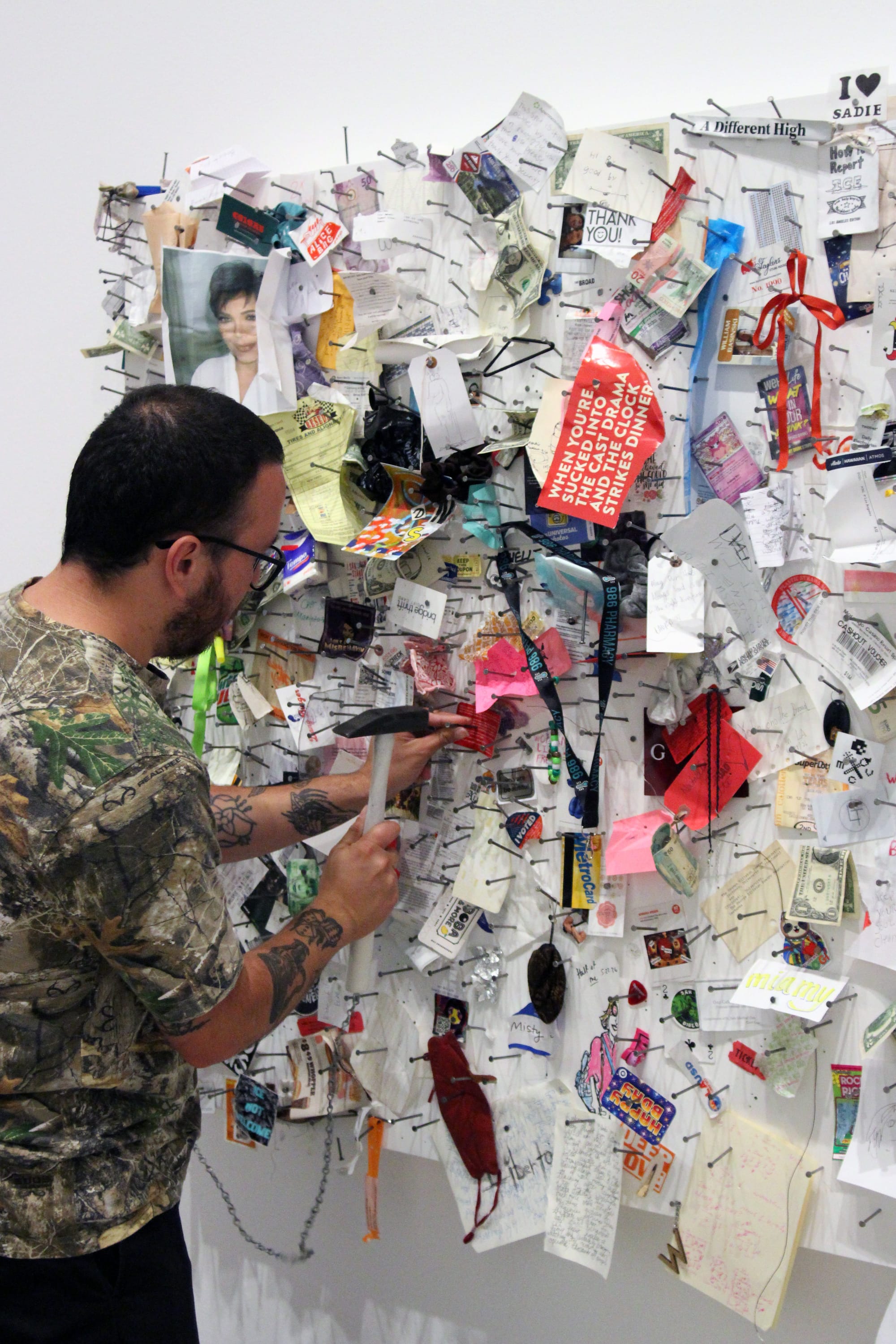
PAINTING TO HAMMER A NAIL
Hammer a nail into a mirror, a piece of glass, wood or metal every morning. Also, pick up a hair that
came off when you combed in the morning and tie it around the hammered nail. The painting ends when it
is covered with nails.
y.o.
A spirit of genroisty pervades Yoko Ono’s work. People, no matter what color, shape, or creed are routinely invited to join on the creation of her work. Many of the largest and most memorable pieces in Music of My Mind such as "Wish Tree and Add Colour (Refugee Boat)" do not exist until someone else joins in its making. Similarly, in "Painting To Hammer A Nail" museum visitors are invited to nail pieces of ephemera to a large white surface to create a massive multi-layered collage. During my visit to The Broad, the objects I saw (and heard) affixed to the piece ranged from Metrocards to dollar bills to magazine tear outs to personal letters of grievance.
The overall experience was wonderfully inclusive. It was also incredibly weird.
For many alive in 2026, it may be hard to remember a time when the people actively shaping culture weren’t obsessed with being liked. Or followed. Or even accepted. We live in a moment when creativity is so informed by self-promotion and the desire to appeal to the largest audience possible, that our Art ends up acting more like advertising. Not fitting in most often means not being seen. The algorithm has many our most interesting minds backed into a corner; if a new creation is to illogical or impractical there’s a pressure to immediately streamline and optimize it. The status quo must be so incessantly reinforced that it’s hard to imagine any other reality could possibly exist.
But you and I know that simply isn’t true, and Ono’s work (along with her fellow Fluxus contemporaries) exist as the record to prove it. Her work reminds us that one doesn’t need to openly pander to an audience to welcome them into the fold. In fact, much of the work in Music of the Mind begins with the notion that you (yes you!) are an intelligent, open-minded individual fully capable of filling in the blanks yourself. That within each us is the creative agency to not only be an active participant in a work in world-class Art museum, but also to change the world as we know it. But first we must come together.
A dream you dream alone is only a dream. A dream you dream together is reality.
y.o.
- We Are Not Doomed To Live This Moment Forever
A PIECE OF SKY
Take a piece of the sky.
Know that we are all part of each other.
y.o.
As one walks through Music of the Mind, the relevancy of its overall message becomes almost overwhelming. The majority of the work was originally made during the 1960s and it reflects a time of social, political and cultural turmoil dreadfully similar to our own. It is a palpable feeling that permeates the show; reinforced by the near constant murmur of other museum goers making their own generational connections out loud.
It is perhaps an understatement to say that we are in dire need of some solutions. Some vision of the future that sees beyond the Apocalyptic inevitability we are being sold through every media outlet imaginable. And this is where Music of My Mind once again meets the challenges of the day.
After making my way through the show, I visited the permanent collection that is housed in the floors above the special exhibition area. I was looking for other moments of applicability; something that would again reassure me that we’d been here before. That this moment in time, with all of its struggle, is just part of a larger work in progress. Then I wandered into the wing dedicated to the work of Ono’s colleague and friend Andy Warhol.
Arguably no other artist in the last 100 years predicted what our current present would be like with more accuracy than Warhol. His preternatural understanding of pop culture seems to have been informed by an incredibly accurate crystal ball. The themes explored in his work: the desensitizing effect of serialized imagery; America’s near religious devotion of corporate branding; and the democratization of celebrity all remain alarmingly prescient. Viewing images of a grieving Jackie Kennedy, a police dog attacking a black man (while racist cops look on indifferently), and an oversaturated portrait of Liz Taylor in such quick succession felt like I had fallen into a 3 dimensional version of Instagram.
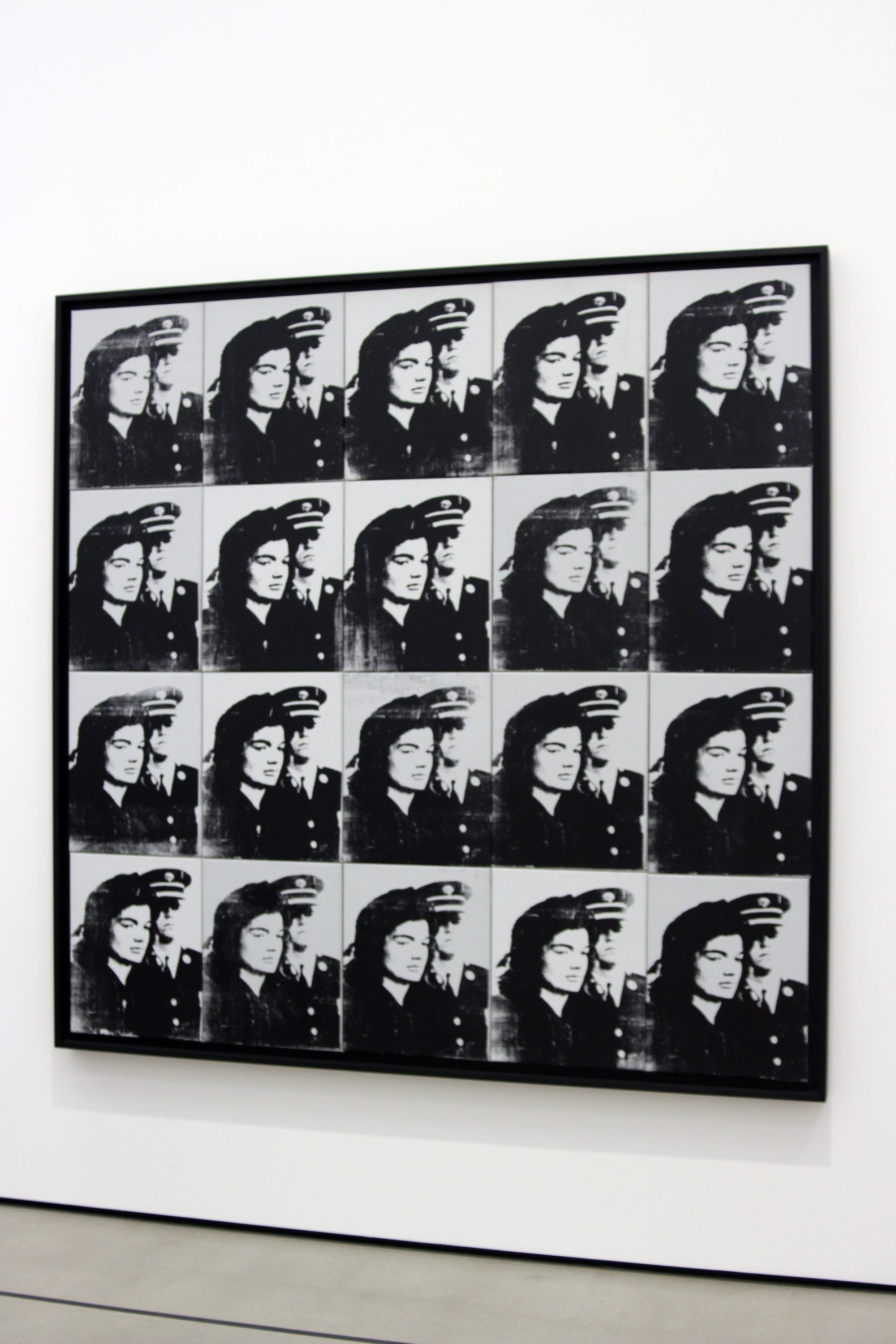
And just like on being Instagram the experience never really resolved itself. I left the room with all of my anxieties about the current state of the world still in exactly the same place as when I entered. Warhol presented no questions. No invitations. No suggestions of an alternative possibility. Just ultra flat pictorial space that blankly stares back at you. With Warhol the vapidity is often the point. His famous reluctance to differentiate between anything - that someone eating or sleeping is just as visually interesting as someone being publicly executed - was unthinkably Avant Garde in his time. Now it just feels like a dead end.
What gives Music of the Mind such power is that Ono understands what’s at stake; then and now. Her crystal ball saw past our present overrun with the worst aspects of humanity, and imagined a future informed by our best.
It ends when its covered with leaves
It ends when the leaves wither
It ends when it turns to ashes
And a new vine will grow
"Painting in Three Stanzas" 1961
- There Is No Single Path Forward
Hang a bottle behind the canvas.
Place the canvas where the west light comes in.
The painting will exist when the bottle creates a shadow on the canvas, or it does not have to exist.
The bottle may contain liquor, water, grasshoppers, ants or singing insects, or it doesn’t have to contain.
1961 Summer.
The title of Ono’s breakthrough 1961 series Instruction Paintings is a playfully contrarian, Conceptual Art misnomer. First, there are no paintings to speak of (at least not in the traditional sense.) Each piece consists of two different texts handwritten in Japanese. Their minimalism pushes the limits of visual interest- nothing more than black text on ivory paper stacked over white text on black paper.
Confusing the matter even further is the fact that the pieces could hardly be described as instructional (at least not in the traditional sense.) Each text is so open ended, so open to interpretation, that it’s easy to imagine that no two people would ever end up with the same result. Which of course is entirely the point.
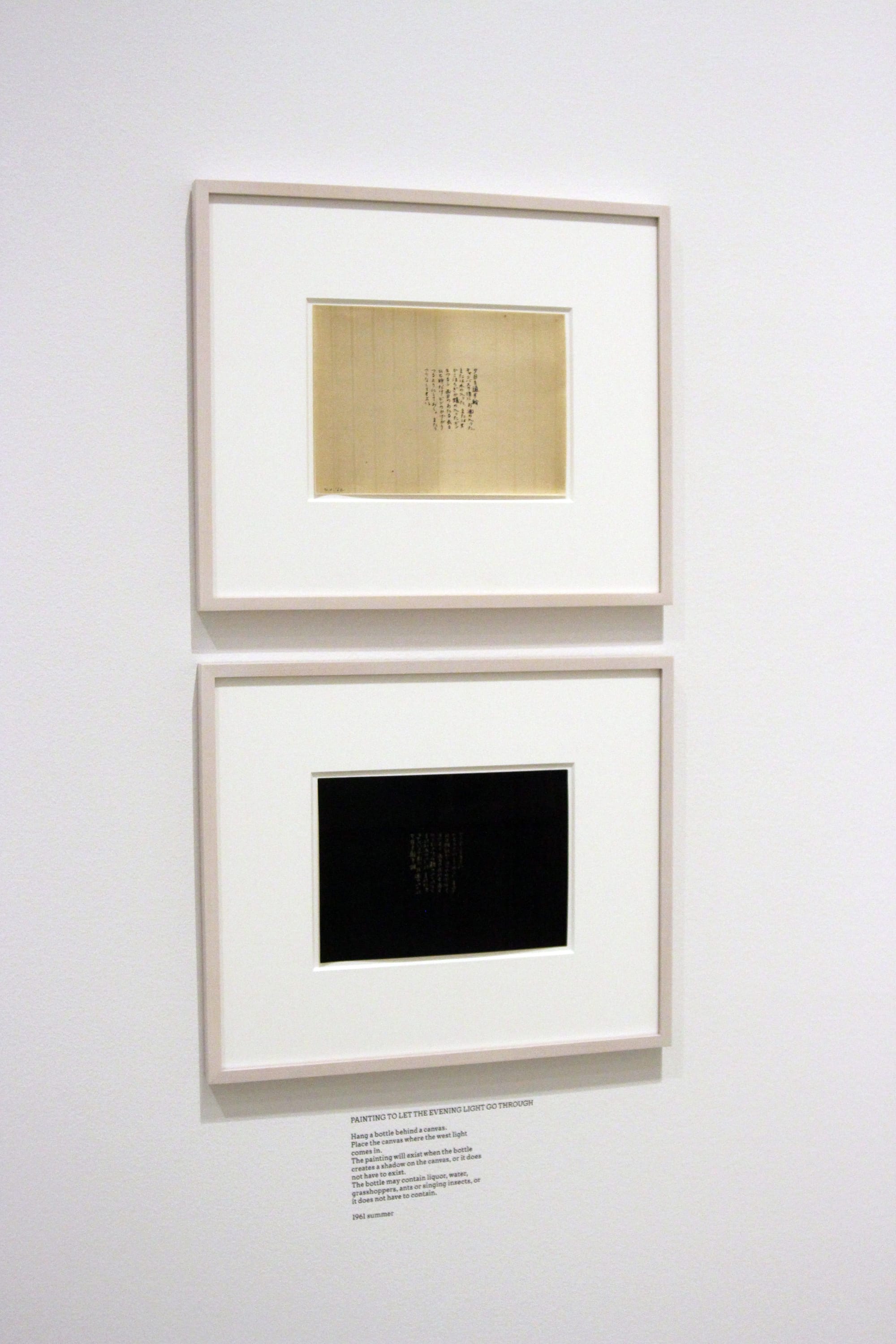
Like so much of Ono’s work, Instruction Paintings act more like a fleeting meditation than a set in stone masterwork. Each piece offers it own series of divergent pathways, in which the viewer is asked to take on the protagonist’s role. Ono’s artistic authority exists only long enough to get the journey started. Often times a line of text will contradict the proceeding one; upending what little bit of governance there was in the first place. Options are included. You may do this or that. Or not even at all.
It’s an open ended dynamic she sets up in her work time and time again. TheInstruction Paintings are incredibly restrained, but they resist the desire to control. Each one is the product of an inescapably singular vision that somehow doesn’t seem feel the need to dominate anything. It’s Ono’s willingness to surrender control that again offers a perspective that can applied to contemporary life (And If it was ever to be fully scaled up, it would become the stuff of revolution.)
Imagine a world where everyone was finally free to shape their own lives. A reality where life’s connections are made by the individual, not a committee or corporation. Ono’s work is a gentle reminder that no one should be allowed to direct another person’s journey. It doesn’t matter if you are an artist, a teacher, a politician, or (especially) a billionaire. What works for me doesn’t need to work for you, and visa versa. And everything in between. All each us can do is collectively recognize the same desire to self actualize in each other. Then give them the room to grow.
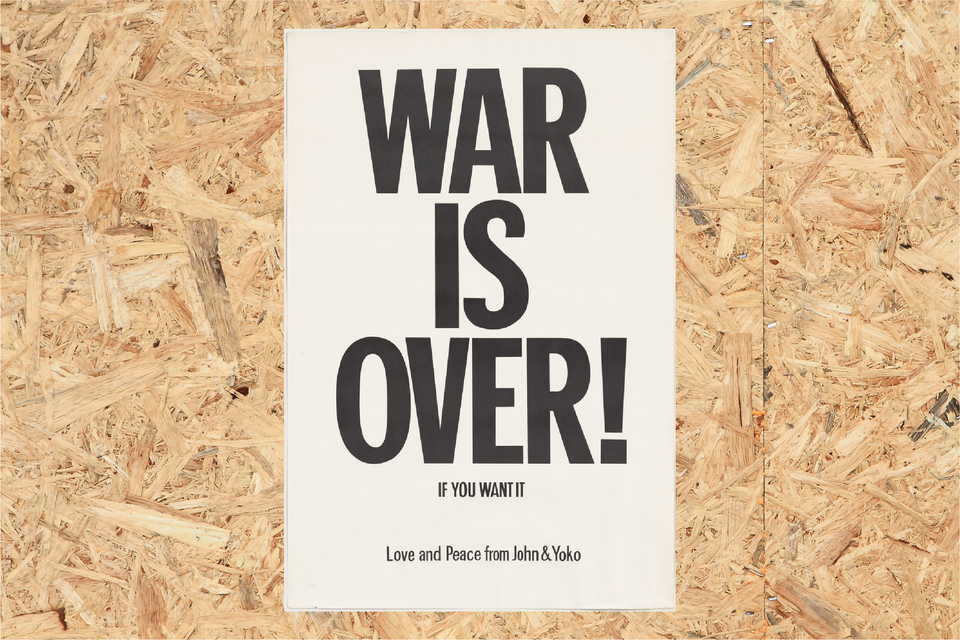
Yoko Ono’s work is a reminder that every single moment offers the possibility of transformation. Sometimes its written in the tiniest of handwriting, and sometimes its in billboard sized Franklin Gothic Extra Condensed:
Peace is Power.
War Is Over.
Yes.
Dalia Association is a community foundation that realizes our rights as Palestinians to control our resources for our own durable development for generations to come. Our mission is to mobilize and properly utilize resources necessary to empower a vibrant, independent, and accountable civil society, through community-controlled grant-making. Our community development approach focuses on the ecological, local economy, social and cultural dimensions
Gonna take an extended break to work on studio stuff and upcoming NNH in-person events. I invite everyone to check out some of the archived posts while were away. Not only is there a ton of good creative stuff (and a few bits of inspired writing) there are links to 30+ mutual aid and social justice groups to support. And if you've seen it all (and still want more) - check out the resource page and replace your doom scrolling with some well deserved hope scrolling.
Free To Give.
Free To Take.
A call to action, commonly known by the initialism CTA, is a strategic marketing tool designed to spur an immediate response from an audience, guiding them toward a specific action.
NNH began with the (perhaps naive) hope that it could be of service to folks who needed it. I wasn't exactly sure who that meant- Was it the potential readership? The Mutual Aid groups that would be featured in each post? Or other creative types (equally fed up with the constant "me at the center" paradigm required by our Tech Overlords) looking for a place to get weird and do some good.
SO, if you're out there- whomever you may be- Let me know. Leave a comment. Click a link. Tell a friend. Pitch an idea. Do anything to feel less alone in the world.

Member discussion